RagingBulls.ai · Volatility & Strategy · 10 min read
When markets turn violent, emotions rise and discipline fades. But AI has no emotions. So who really wins when volatility explodes?
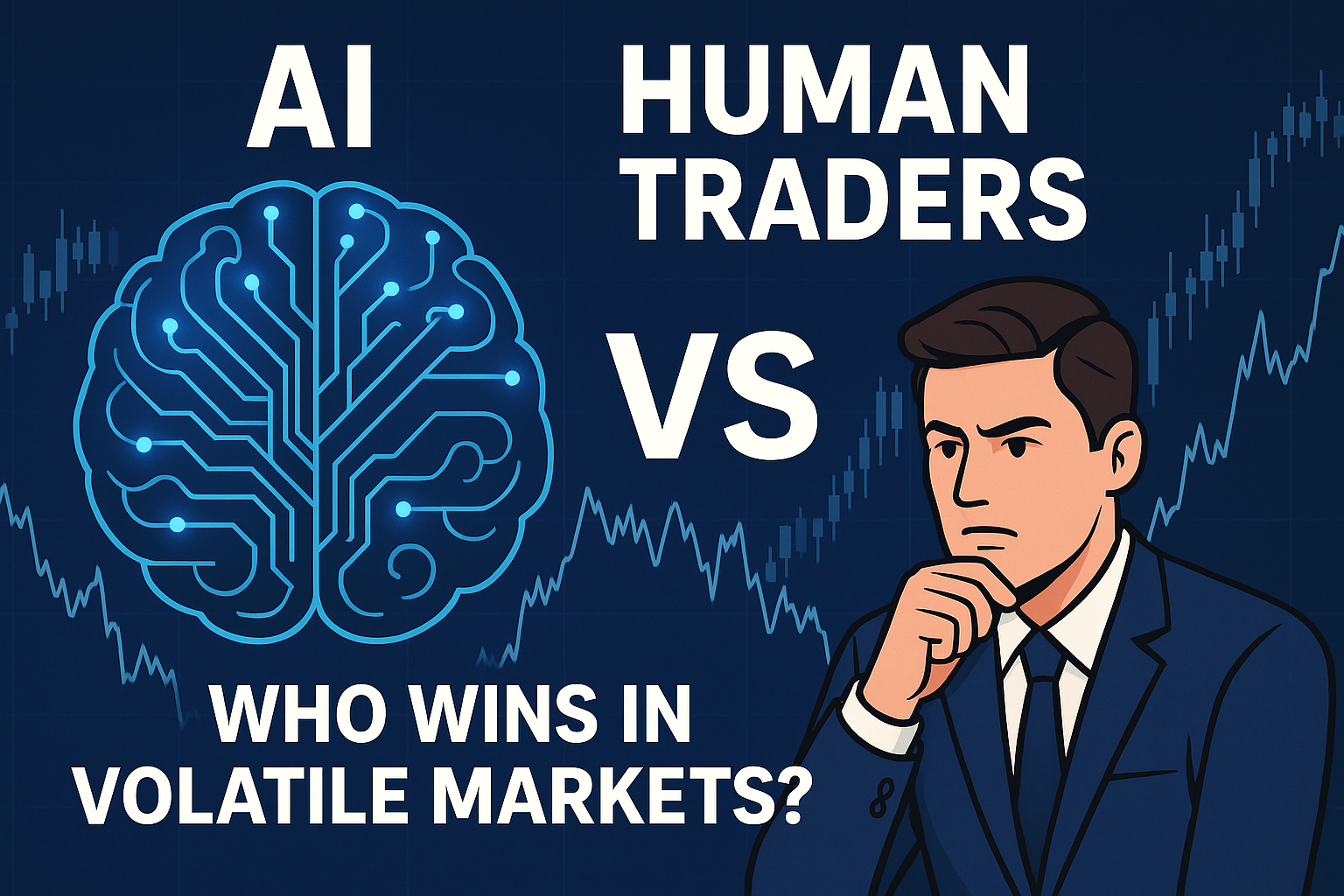
Introduction: Volatility — Playground or Battlefield?
Some traders live for volatility—the sudden spikes, the rush of opportunity, the high-stakes decisions made in seconds. Others fear it, stepping back the moment candles stretch erratically and news headlines explode.
But in between this chaos, one big question is rising across global markets:
“Markets don’t punish the uninformed—they punish the emotional.”
Volatility exposes weaknesses in decision-making. Humans crack under pressure, while AI models process order flow, sentiment signals, volume anomalies, and correlation breakdowns in milliseconds—without anxiety, greed, or overconfidence. This battle isn’t about who is smarter. It’s about who stays disciplined when the heat rises.
When Fear Hits the Market: Humans Panic, AI Computes
During high-volatility events—Fed announcements, biotech approvals, earnings surprises, or geopolitical shocks—we see the same pattern: social feeds trend tickers, news channels explode with speculation, options volume surges, and the average retail trader acts on emotion, not logic.
Callout: Discipline beats drama. AI doesn’t feel drama.
Snap Comparison
| Human Reaction |
AI Reaction |
| “Oh no, it’s crashing—get out!” |
Quantifies order flow imbalance and checks if pressure is real or panic-driven. |
| Doom-scrolls social media |
Scans real-time sentiment across thousands of feeds and scores intensity. |
| Over-leverages to “catch the move” |
Allocates with risk-adjusted exposure from proven volatility models. |
| Decides by guesswork |
Executes probability-weighted signals with preset controls. |
 Infographic 1 — Human vs AI reaction timeline in a volatility spike.
Psychology: The Biggest Edge AI Has Over Humans
Human traders fight two enemies: the market and their own mind. AI fights only the market. When a stock spikes 30% in minutes—think mega-cap momentum or biotech approvals—humans cycle through hesitation, late entry, regret, and revenge trading. AI, instead, calculates probability zones.
AI’s Questions in the First Seconds
- Was there an abnormal volume surge?
- Are block trades entering or exiting?
- Is the move news-driven or liquidity-driven?
- What is the likely mean-reversion window?
- Which historical pattern does this match, and what followed then?
“Humans remember pain. AI remembers data.”
Human Biases That Derail Performance
| Bias |
Behavior in Volatility |
Result |
| Loss Aversion |
Holding losers too long, cutting winners too fast |
Shrinks growth potential |
| Confirmation Bias |
Seeking news that supports current position |
Blind to reversal signals |
| FOMO |
Entering after majority of the move is done |
Low reward, high risk |
| Overconfidence |
“I knew it” mindset after a win |
Risk creep without logic |
| Anchoring |
Waiting for price to “come back to entry” |
Misses momentum and adds drawdown |
How AI Actually Handles Volatility
AI trading isn’t mystical prediction. It’s structured pattern exploitation with dynamic risk. Systems tag repeating volatility events and assign a probability confidence score. During sudden spikes, models evaluate:
- Volume Imbalances — Are big players entering or exiting?
- Order Book Heatmaps — Is liquidity absorbing or vanishing?
- Sentiment Velocity — Is chatter bullish or panic-toned?
- Correlation Breaks — Is the stock decoupling from its sector or index?
- Pattern Database Matches — What did this setup do historically?
 Infographic 2 — Flash-crash decision flow: emotion vs logic framework.
“When humans see chaos, AI sees structure.”
Case Study: Flash-Crash Moment—Who Responds Better?
Imagine a small-cap biotech jumps +40% in five minutes on an unexpected FDA headline.
Typical Human Paths
- Chase: Buys at the top, gets dumped on.
- Freeze: Skips the trade, watches another +20% move.
- Fight: Shorts into the squeeze, exits in panic.
Programmatic AI Response
- Flags news anomaly + unusual options activity.
- Waits for first profit-taking wick to form.
- Enters only if volume dries but price holds.
- Sets stops using relative ATR instead of emotion.
Conclusion: AI doesn’t chase. It calculates entry zones and risk mathematically.
Where Humans Still Have a Narrow Edge
Humans can beat AI on pre-confirmation intuition: spotting catalysts before data prints—like noticing pre-market chatter, upcoming hype cycles, or executive behavior tells. But once the move begins, AI typically reacts faster, sizes smarter, and manages risk better.
“Humans spark trends. AI capitalizes on them.”
Final Verdict: Who Wins?
| Criteria |
Human Traders |
AI Systems |
| Speed |
? |
? |
| Emotion Control |
? |
? |
| Pattern Recall |
? |
? (thousands of events) |
| Cutting Losses |
Inconsistent |
Programmatic |
| Position Scaling |
Variable |
Risk-weighted |
| Holding Without Fear |
Rare |
Default |
Verdict: In volatile markets, AI wins more often—not because it’s smarter, but because it’s unemotional, data-driven, and repeatable.
Trade Volatility with Discipline—Not Emotion
If you want to navigate violent swings with real-time signals and risk logic, let AI do the scanning.
Try RagingBulls.ai Momentum Scanner — built for traders who prefer data discipline over chaos.