What is a Stock, Share, Equity? (Beginner-Friendly Guide)
Introduction
Thinking about investing for your future? The words stock, share, and equity often come up, but they can sound confusing if you’re new to the world of investing. Understanding what a stock, share, or equity is—the building blocks of the financial markets—opens the door to smart investing and growing your wealth.
Clarity in Simple Terms: A stock (or share or equity) means ownership in a company, even as little as one tiny slice!
Imagine owning a piece of your favorite company, like a slice of a big, delicious pizza—that's what holding a share or stock feels like!
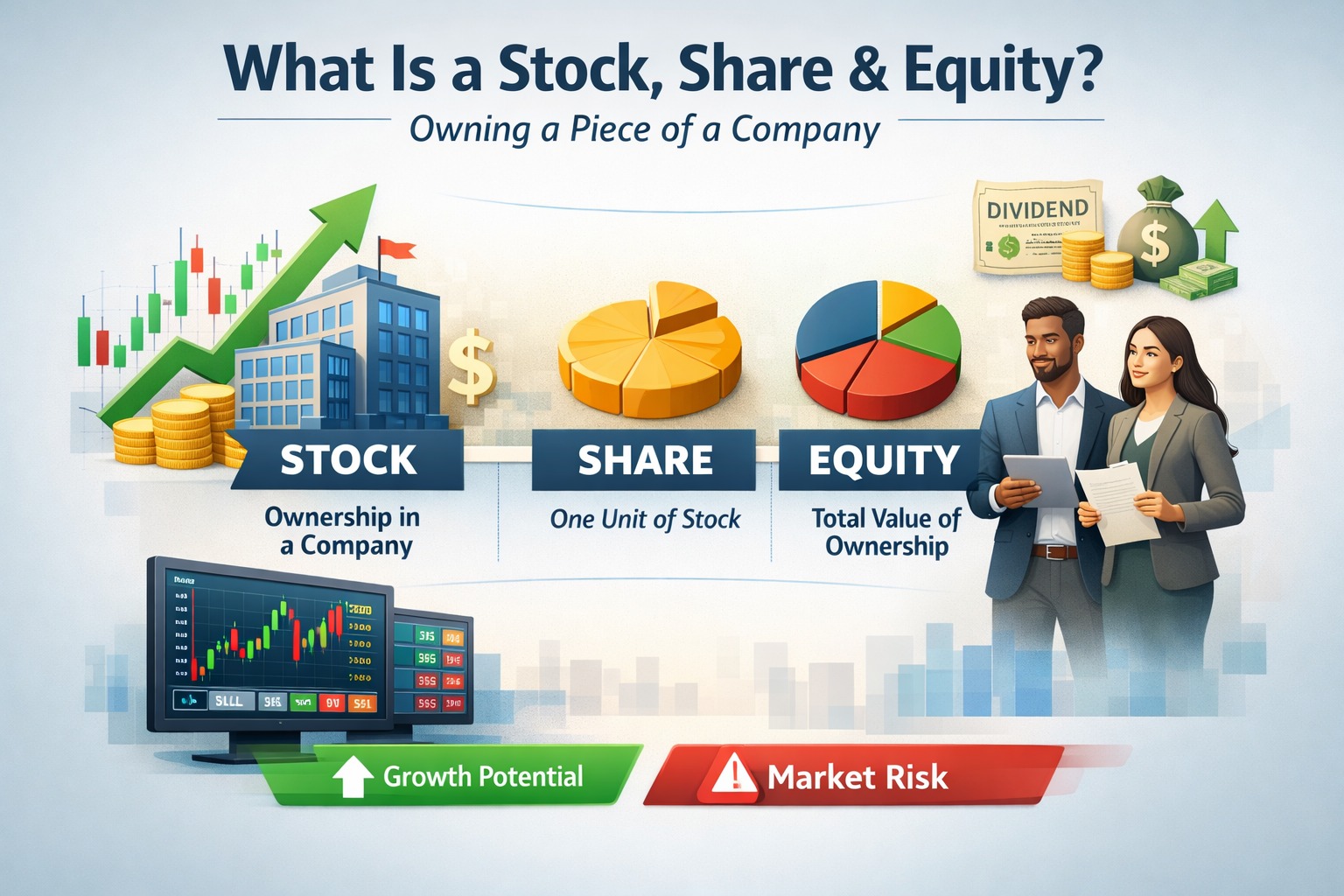
Step-by-Step Guide: What is a Stock, Share, Equity?
- Definition:
- Stock means part ownership in a company. If you have a company's stock, you are one of its owners (even if very small).
- Share usually refers to an individual unit of stock. If a company has 1,000 shares and you buy 10, you own 1% of the company.
- Equity is a broader term, meaning “ownership” in a business, often used interchangeably with stock or share.
- How It Works:
- Companies issue stocks to raise money for growth.
- Investors (like you!) buy these shares on a public exchange (like the NYSE or NASDAQ).
- Your stocks can go up (or down) in value based on how the company performs.
- You may get dividends (a share of the profit) or, if the company grows, your shares become more valuable.
- Types of Stocks:
- Common Stock: Most popular, gives voting rights and possible dividends.
- Preferred Stock: Higher claim on earnings (dividends first), but usually no voting rights.
- Buying Your First Share:
- Open a brokerage account (online, quick and easy!)
- Deposit money into your account.
- Select a company you want to invest in (for example: Apple, Google, etc.)
- Choose how many shares you want—hit “Buy”—and you're a shareholder!
Detailed Breakdown
Stocks, shares, and equity all mean ownership in a company, just on slightly different levels:
- When you buy a stock or share, you own a piece of that company.
- Owning shares can give you voting power at company meetings and a right to a portion of profits.
- If the company performs well, your investment can grow in value. If the company struggles, your stock can lose value.
- Stocks are bought and sold on stock markets, which are like digital marketplaces.
Advantages of Investing in Stocks, Shares, Equity
- Potential for strong growth: Stocks have historically offered better returns over the long term compared to savings accounts or bonds.
- Ownership: You own a part of a real company.
- Liquidity: Easy to buy and sell, as markets operate daily.
- Dividends: Some shares pay you a regular income, even if you don’t sell.
- Flexible Investment Amounts: Buy as little as one share—you don’t need to be rich to start!
Disadvantages of Stocks, Shares, Equity
- Risk: The stock price can drop, meaning you could lose money.
- Volatility: Prices can change a lot in a short time.
- No guaranteed returns: Unlike a savings account, gains aren’t certain.
- Emotional Stress: Watching prices move up and down can be nerve-wracking for beginners.
Alternative Investment Options
- Bonds – Lending money to companies or governments for regular interest payments.
- Mutual Funds – Pooling money with other investors to buy a basket of assets (including stocks and bonds).
- ETFs (Exchange-Traded Funds) – Similar to mutual funds but traded like stocks.
- Real Estate – Buying property for rental income or growth in value.
- High-Yield Savings Accounts – Lower risk, lower returns, steady interest.
Beginner’s Tips
- Start small — invest only what you can afford to lose and learn as you go.
- Diversify — don’t put all your money into one company.
- Stay calm — ignore daily price swings, think long-term.
- Research — learn about companies before you invest in them.
- Never invest based on rumors or social media hype.
Advanced Variations for Experienced Traders
- Options and Derivatives: Advanced products to speculate or protect your stock investments.
- Short Selling: Profiting when a stock goes down, not recommended for beginners.
- Margin Trading: Borrowing money to buy more shares, increasing both potential gains and losses.
- Dividend Investing: Focusing on companies that regularly pay cash dividends to shareholders.
FAQs: Stocks, Shares, Equity
Q: Are “stocks,” “shares,” and “equity” the same?
A: They all refer to ownership in a company, but “stock” is the general term, “shares” are individual units, and “equity” is the broader concept of ownership.
Q: Can I lose all my money by buying stocks?
A: If the company goes bankrupt, it’s possible, but it’s rare for major companies. Diversifying helps reduce this risk.
Q: How do I start investing in stocks/shares?
A: Open a brokerage account online, fund it, research companies, and start investing!
Q: Do I get paid just by owning stocks?
A: Sometimes. Some companies pay dividends (profit sharing), but not all companies do.
Ready to start your journey? Understanding stocks, shares, and equity is the first step in smart investing and building your financial future!