Settlement (T+2, Dividends, Splits): The Complete Beginner's Guide
Introduction
Are you new to investing and puzzled by terms like settlement (T+2, dividends, splits)? Understanding how your investments are finalized, when you receive payments like dividends, or why the number of shares changes after a stock split is vital. The core idea? Settlement (T+2, dividends, splits) ensures clear, timely, and accurate handling of each trade you make.
Imagine buying a cool gadget online. There's a payment, shipping, and then delivery — each step must happen in order. Stock trading works similarly! Let’s break down these concepts simply.
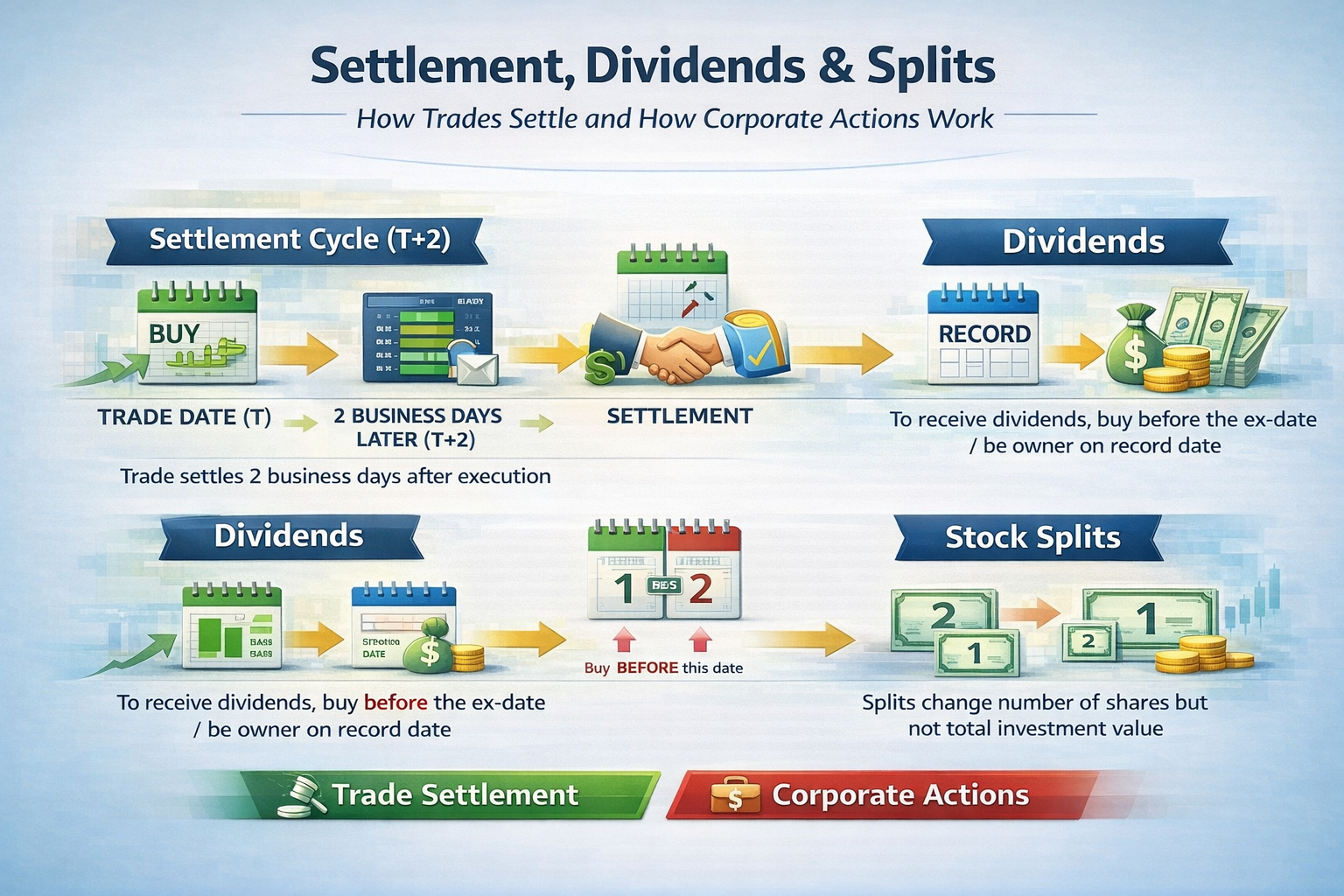
Settlement (T+2, Dividends, Splits) Explained
- Settlement: This is the official completion of a securities trade. After buying or selling stocks, cash and shares are exchanged between buyer and seller.
- T+2: Means "Trade date plus 2 days". Settlement occurs two business days after the trade is executed.
- Dividends: Cash payments or additional stocks companies give to shareholders, typically from profits.
- Splits: When a company increases (or decreases) its number of shares, adjusting the price per share without changing the company's total value.
Essence: Settlement (T+2, dividends, splits) provides clarity, ensuring every trade is finalized fairly and on time.
Relatable Hook:
Ever wondered why money from your stock sale doesn't arrive instantly, or why a stock's price suddenly halves but the value stays the same? That’s settlement (T+2, dividends, splits) at work!
Step-by-Step Guide: Understanding Settlement (T+2, Dividends, Splits)
- Making a Trade: Place a buy or sell order for stocks through your broker.
- Trade Date ("T"): The day your order goes through is known as the trade date.
- Waiting for T+2: Settlement happens two business days after the trade date. Cash and stocks move between accounts.
- Ex-Dividend Date: To qualify for declared dividends, you must buy the stock before the ex-dividend date (usually set one business day before the record date).
- Record Date: The company checks its records to see who qualifies for dividends.
- Dividend Payment: Eligible shareholders receive dividends on the payment date (cash or more shares).
- Stock Splits: When a split happens (e.g., 2-for-1), your share count doubles, but the price per share halves. Your total investment value remains the same.
In-Depth: Settlement (T+2, Dividends, Splits)
- Why T+2? The two-day period helps brokers ensure all details are correct, payments clear, and share ownership is transferred efficiently.
- Dividends: Can be in the form of cash (direct payment) or stock (more shares). You must own the stock before the ex-dividend date for eligibility.
- Splits: Companies use splits to make shares more affordable to new investors without changing your total investment value.
Advantages of Settlement (T+2, Dividends, Splits)
- Fast, reliable process for finalizing trades.
- Clearly defined rules for receiving dividends and stock splits.
- Helps keep the stock market fair, standardized, and efficient.
- Makes trading transparent for beginners and professionals alike.
Disadvantages
- Delay: Cash or shares transfer after T+2, which might be inconvenient if you need instant access to funds.
- Missed dividends: Buying on the ex-dividend date or later means missing recently declared dividends.
- Confusion: Stock splits can confuse beginners as the share count and price change.
Alternative Investment Options
- ETFs & Mutual Funds: These funds handle settlements and dividends for you, simplifying the process.
- Robo-Advisors: Automated platforms that manage settlement (T+2, dividends, splits) behind the scenes.
- Bonds: These have their own settlement rules but can offer regular fixed income.
Beginner's Tips for Settlement (T+2, Dividends, Splits)
- Check the settlement (T+2) period before planning to access your trading funds.
- To receive dividends, always buy before the ex-dividend date.
- Don’t panic after a stock split; your total investment value stays the same.
- Set reminders about record and payment dates for dividends.
Advanced Strategies (For Experienced Investors)
- Use "dividend capture" by trading strategically around ex-dividend dates.
- Manage tax implications by understanding settlement schedules and dividend types (qualified vs. non-qualified).
- Track corporate actions (splits, mergers, bonus issues) for advanced portfolio management.
Frequently Asked Questions (FAQs)
- What does T+2 mean in settlement?
- It stands for "trade date plus two business days" — the time it takes for a stock trade to finalize.
- Why didn't I receive a dividend?
- You might have bought the stock on or after the ex-dividend date, making you ineligible for the latest payout.
- After a split, do I lose money?
- No! The investment value stays the same; only the number of shares and price per share change.
- Can I sell my stocks during the settlement (T+2) period?
- Yes, but if you do, your broker will manage the process and ensure settlement dates don't overlap.
Conclusion
Mastering settlement (T+2, dividends, splits) is key for every investor. It ensures your trades are processed safely, you receive your rightful dividends, and you understand changes after splits. Keep these steps and tips in mind, and you’ll trade with greater confidence and clarity!