Understanding Market Indices: S&P 500, Dow Jones, and Nasdaq Composite
Introduction
Curious about market indices like the S&P 500, Dow Jones Industrial Average (often just called "the Dow"), and Nasdaq Composite? These major indices tell us how the overall US stock market—or big slices of it—is performing. In simple terms, they’re “scoreboards” for groups of stocks, giving you a quick snapshot of market health.
If you’ve ever wondered whether the whole market is up or down in a day—without digging into hundreds of stocks—tracking market indices is how you do it!
Step-by-Step Guide: How Market Indices Work
- Understand What an Index Is:
- An index, like the S&P 500, Dow, or Nasdaq, tracks a specific group of companies.
- Think of it as a “mini-market” that shows how that particular set of stocks is performing.
- Meet the Big Three:
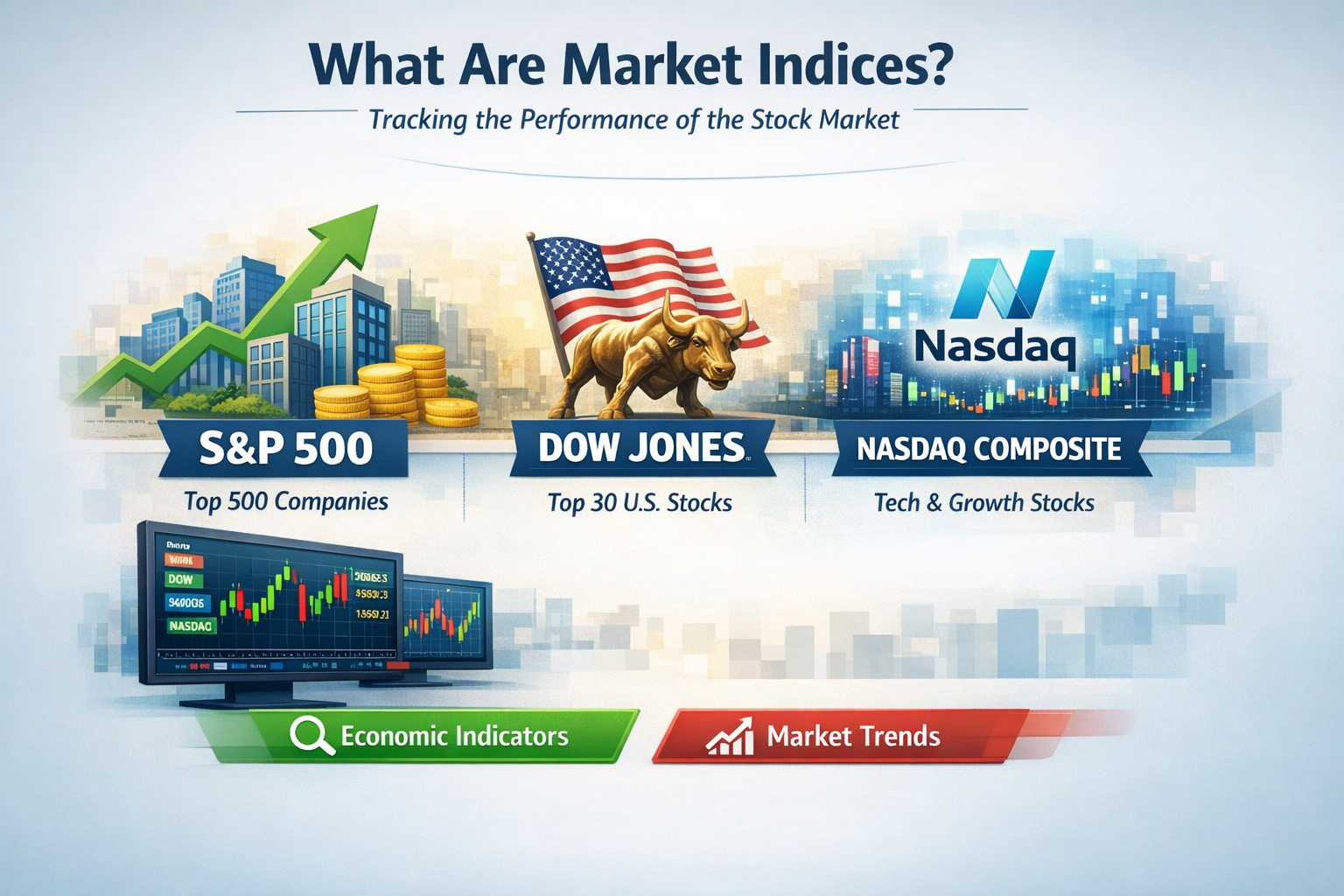
- S&P 500: Tracks 500 large US companies from all major sectors (Apple, Amazon, ExxonMobil, etc.).
- Dow Jones (Dow): Follows 30 major US companies, like Coca-Cola or Disney; it's price-weighted (stocks with higher share prices matter more).
- Nasdaq Composite: Tracks 3,000+ stocks mostly from tech and growth companies (like Microsoft, Google, Tesla).
- How the Indices Are Calculated:
- S&P 500: Market-cap weighted (bigger companies have more influence).
- Dow: Price-weighted (companies with higher prices move the index more).
- Nasdaq: Market-cap weighted, but focused on technology and growth.
- Why Track Them?
- They act as a “report card” for the market or sectors.
- Many mutual funds, ETFs, and retirement funds use these indices as benchmarks for your investments.
- How to Invest in Them:
- You can’t invest directly in an index like the S&P 500 or Dow, but you can buy mutual funds or ETFs that try to match their performance.
- Popular examples: Vanguard S&P 500 ETF (VOO), SPDR Dow Jones ETF (DIA), Invesco QQQ Trust (tracks the Nasdaq 100).
{C}
Advantages of Market Indices
- Diversification: By tracking an index, you’re spreading your investment across many companies instead of betting on just one.
- Lower Risk: If one company has a bad day, others in the index may balance it out.
- Simple Performance Tracking: Easy to see how the general market is doing without analyzing dozens of stocks.
- Accessible: Many funds and ETFs mirror these indices, making index investing easy for beginners and low-cost.
{C}
Disadvantages of Market Indices
- Limited Upside: You won’t “beat the market” because you are matching it.
- Market Risk: If the whole market drops (like in a recession), your investment will likely fall too.
- No Control Over Companies: You don’t get to choose the companies in the index—they’re selected by the index provider.
- Sector Weighting: Indices like S&P 500 may be heavily influenced by a few large companies (e.g., Apple, Microsoft).
{C}
Alternative Investment Options
- Sector ETFs: Focus on specific industries, such as healthcare or energy.
- Dividend Funds: Invest in companies with regular dividend payouts.
- International Indices: Try indices outside the US, like Europe’s STOXX or Japan’s Nikkei.
- Individual Stocks or Bonds: More control, but higher risk and research needed.
Beginner’s Tips
- Start Small: You don’t need thousands to get started. Many apps let you buy fractional shares of index ETFs.
- Go Long-Term: Indices are best for long-term growth—don’t stress over daily ups and downs.
- Automate Investing: Set up automatic contributions to your index fund to build wealth gradually.
- Research ETF Costs: Look for funds with low fees to maximize returns.
Advanced Variations for Experienced Traders
- Leveraged ETFs: Aim to amplify daily gains (though they can boost losses too). Suitable only for advanced traders.
- Short or Inverse ETFs: Profit when an index like the S&P 500 or Nasdaq goes down—high risk!
- Options and Futures: Trade contracts based on index performance for risk management or speculation (requires experience).
FAQs about Market Indices
- What is the S&P 500? — It’s an index tracking 500 of the largest US companies, seen as a reliable measure of overall US stock market health.
- How is the Dow Jones different from the Nasdaq? — The Dow tracks 30 large companies and is price-weighted; the Nasdaq Composite tracks thousands, mostly in tech, and is market-cap weighted.
- Can I lose money investing in market indices? — Yes. Like any investment, index funds can go up or down, especially short-term. Broad diversification, however, can help reduce individual company risk.
- Which market index is “best” for beginners? — Many people start with S&P 500 index funds for broad exposure and low cost.
Conclusion
Market indices like the S&P 500, Dow, and Nasdaq Composite are powerful tools for both beginner and pro investors. They offer a window into the health of the market and a straightforward, diversified way to invest. Whether you’re just starting or looking to expand your portfolio, market indices provide clarity, simplicity, and proven long-term growth. Start learning today, and remember—investing is a journey!