Win Rate, Expectancy, and R-Multiples: Your Complete Beginner’s Guide
Introduction
Entering the world of trading and investing can feel overwhelming. But don’t worry—understanding just a few essential concepts can dramatically boost your confidence and results. Among these, Win Rate, Expectancy, and R-Multiples stand out as the keys to unlocking trading success. In this guide, we simplify their meaning, usage, and benefits, making your trading journey clearer and more rewarding.
What Are Win Rate, Expectancy, and R-Multiples?
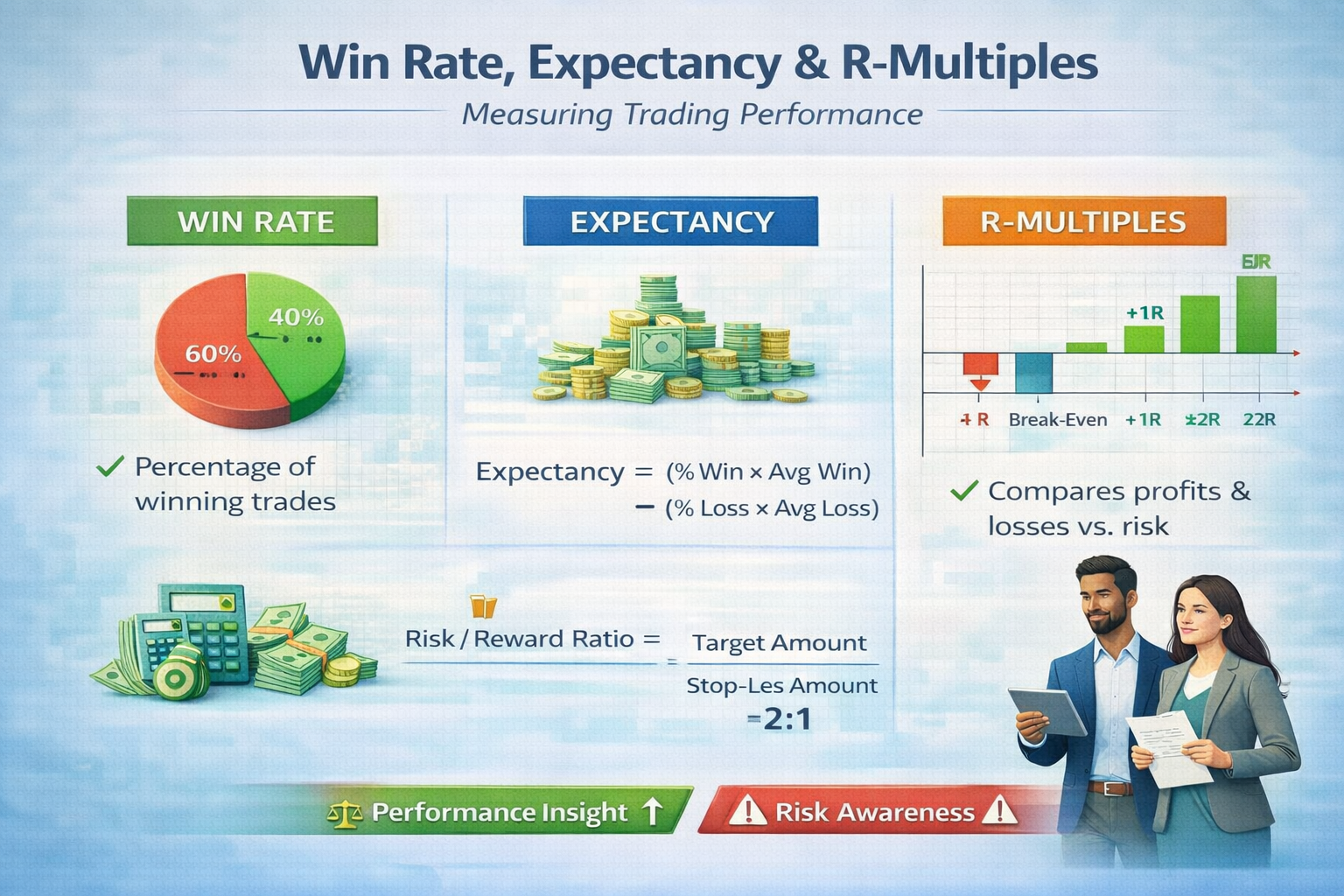
Win Rate shows the percentage of your trades that close with a profit.
Expectancy estimates your average profit or loss per trade over time.
R-Multiples help you measure your trades’ profits or losses relative to the amount you risked.
In essence: These tools bring clarity to your trading performance, helping you make smarter decisions and grow more confident.
Imagine playing a game where you want to win more than you lose, and you want your wins to be big enough to cover your losses. Win Rate, Expectancy, and R-Multiples are your scorecards!
Relatable Hook for Beginners:
Ever felt like your trading is a mix of luck and guesswork? Tracking your win rate, expectancy, and R-multiples can replace uncertainty with science—and help you trade smarter, not just harder.
Step-by-Step Guide
- Start Tracking Your Trades
Keep a simple journal or spreadsheet of each trade—just the entry, exit, profit/loss, and the amount you risked.
- Calculate Win Rate
- Count your winning trades in a set (say, over 1 month).
- Divide by the total number of trades—get a percentage.
- Example: 6 wins out of 10 trades = 60% win rate.
- Find Your R-Multiple per Trade
- R-Multiple = Profit or Loss ÷ Initial Risk.
- If you risk $50 and make $100: R-Multiple is 2. If you lose $50: R-Multiple is -1.
- Calculate Expectancy
- Average your R-Multiples over many trades (add the R’s together and divide by the number of trades).
- If your average R-Multiple is above 0, you’re on the right track!
- Review & Adjust
Use these numbers to see if your strategy works. If not, tweak your approach.
Advantages
- Clarity: Know instantly if your strategy is working.
- Confidence: Base decisions on real numbers, not emotion.
- Risk Control: R-Multiples keep your risks—and rewards—clear and measured.
- Progress Tracking: Expectancy shows if you’ll make money over many trades, not just get lucky.
- Goal Setting: Helps you target improvements—raise your win rate, risk/reward ratio, or both!
Disadvantages
- Learning Curve: Requires keeping good records and a little math.
- No Guarantees: Even a high win rate doesn’t protect you from large losses.
- Short-term Variance: Numbers can look odd with too few trades (track at least 20-30).
Alternative Investment Options
- Index Funds: Simple, diversified, and great for hands-off investing.
- Robo-Advisors: Automated portfolios with less tracking needed.
- Dividend Stocks: Grow wealth and receive regular income.
- ETFs: Choose a basket of assets to spread risk, no constant monitoring required.
Beginner’s Tips
- Start small—track just 10-20 trades for practice.
- Don’t obsess about being right every time; focus on your average results.
- Use stop-losses to stay disciplined and define your risk per trade.
- Review your win rate, expectancy, and R-multiples monthly for progress.
Advanced Variations for Experienced Traders
- Break down expectancy for separate setups or market conditions.
- Refine R-Multiples by factoring in commissions or slippage.
- Use a rolling average to spot changes in your strategy effectiveness over time.
- Pair with position sizing formulas for maximum portfolio growth.
FAQs: Win Rate, Expectancy, and R-Multiples
What is a “good” win rate?
Win rates over 50% are often seen as good, but even a 40% win rate can be profitable—if your wins are bigger than your losses.
What if my expectancy is negative?
Your strategy may be losing money in the long term. Review your entries, exits, and risk amount.
How many trades do I need to track?
For best results, aim for 20–30 trades minimum before drawing conclusions.
Can win rate, expectancy, and R-multiples help with all asset classes?
Yes! Whether stocks, forex, crypto, or options, these concepts apply.
Conclusion
Mastering win rate, expectancy, and R-multiples can transform the way you see your trading or investments. They replace guesswork with insight, boost your confidence, and help you make steady progress toward your goals. Everyone—beginners or seasoned traders—can benefit by using these simple yet powerful scorecards in their decision-making journey.
Start tracking today, grow your understanding, and let clarity guide your next move.