Volume Analysis (OBV, Accumulation/Distribution): A Friendly, Beginner's Guide

Introduction

Are you curious about how volume analysis can give you clues about where a stock is headed? Whether you’re a trader, investor, or just learning, understanding what moves the market beyond just price can open new doors for your decision-making skills. The essence of volume analysis lies in clarity: it helps you read the "story" between the price and how many people are buying or selling.

We’ll cover two of the most respected volume-based indicators: On-Balance Volume (OBV) and the Accumulation/Distribution Line. These may sound complex, but stick with us—by the end of this guide, you’ll know exactly how to use them to your advantage!

Ever looked at a stock chart and thought, "I know the price, but why did it really move?" Volume analysis helps answer that question!
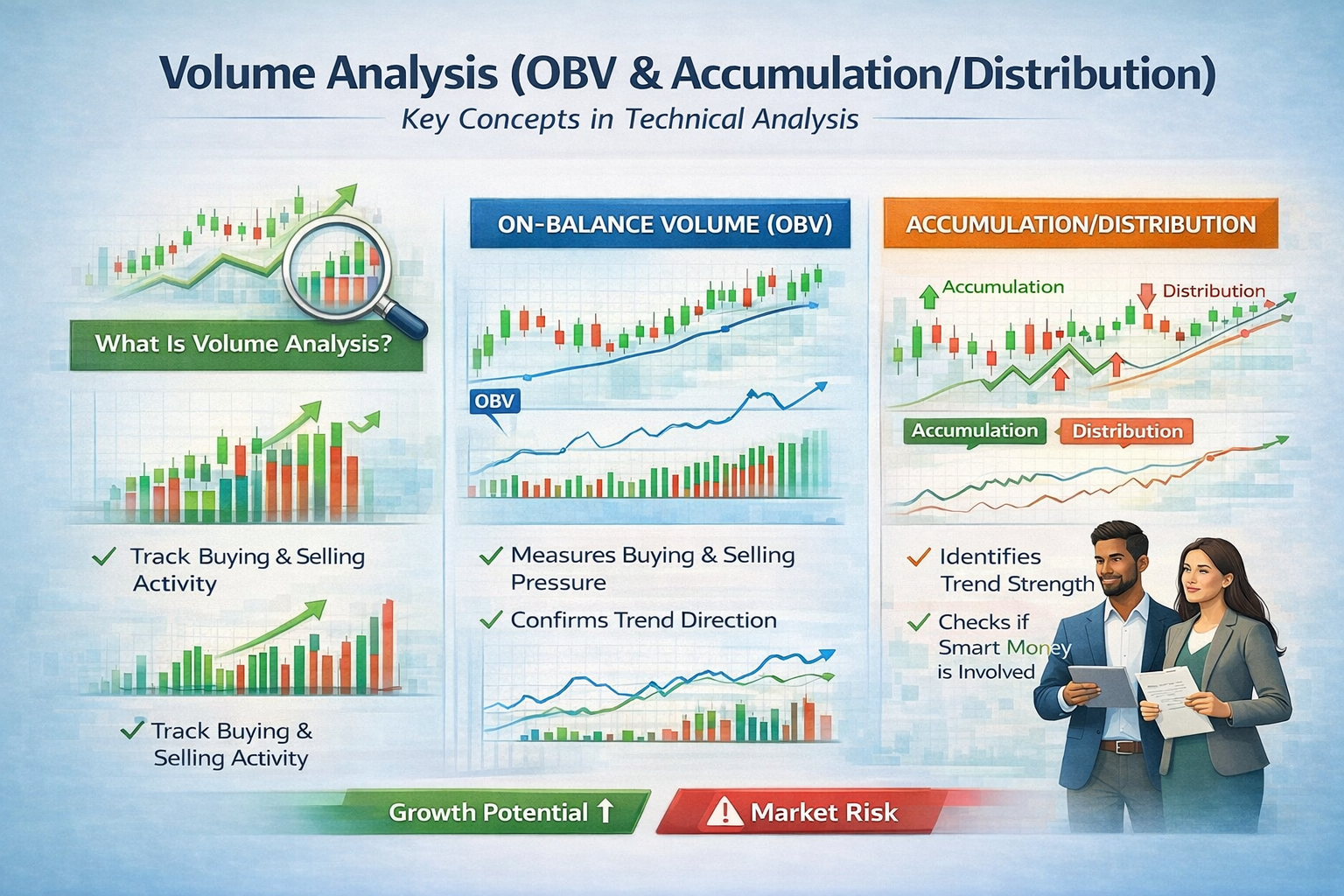
 

Volume analysis
 

What Is Volume Analysis?

Volume analysis is the study of trading volumes (the number of shares or contracts traded within a given period) and how they relate to price movements. Think of it as the “heartbeat” of the market—helping you understand the strength behind a price move.

  • On-Balance Volume (OBV): Tracks buying and selling pressure by adding volume on up days and subtracting it on down days.
  • Accumulation/Distribution: Measures the cumulative flow of money into and out of a stock, considering both price and volume.

Essence: Volume analysis gives you clarity on whether a price move is trustworthy or likely to fade.

Step-by-Step Guide: How to Use OBV and Accumulation/Distribution

  1. Choose Your Charting Platform: Most trading platforms have built-in tools for OBV and accumulation/distribution lines.
  2. Add the Indicators:
    • Look for “Indicators” or “Technical Analysis” menu.
    • Select “On-Balance Volume (OBV)” or “Accumulation/Distribution Line.”
  3. Observe the Trend:
    • If the OBV line is rising, buying pressure may be strong (bullish sign).
    • If OBV is falling, selling may be taking over (bearish sign).
    • With accumulation/distribution, an upward sloping line suggests accumulation (money flowing in), while a downward slope suggests distribution (money flowing out).
  4. Compare OBV/Accumulation to Price:
    • If volume indicators move in the same direction as price, the trend could be strong.
    • If the indicator and price diverge (move in opposite directions), it could signal a reversal or weakening trend.
  5. Use for Confirmation: Pair volume analysis with other indicators (like moving averages or RSI) before making trading decisions.

Breaking Down the Concepts

  • OBV (On-Balance Volume): Takes daily volume and adds or subtracts it based on whether the price closed higher or lower. Steady upward moves suggest buyers are active; downtrends hint sellers are in control.
  • Accumulation/Distribution: Calculates the “flow” of money by combining price and volume. It considers how close the closing price is to the day’s high or low, making it sensitive to days when price closes strongly up or down.

These indicators aim to reveal the “real” market sentiment behind the scenes—helping you spot strong moves or upcoming reversals.

Advantages of Using Volume Analysis

  • Confirmation of Trends: Volume indicators back up price moves, reducing the risk of false breakouts.
  • Divergence Signals: Spot possible reversals early when price and volume trends don’t match.
  • Simple Visualization: Both OBV and the accumulation/distribution line are easy to read, even for beginners.

Disadvantages of Volume Analysis

  • Not Foolproof: Large volume spikes can be caused by one-off news events, not genuine trend shifts.
  • Lags the Market: Some signals may come after the trend has already started.
  • Works Best with Other Tools: On its own, volume analysis is powerful—but it’s safer when combined for extra confirmation.

Alternative Investment Analysis Methods

  • Moving Averages: Smooth out price data to see trends more easily.
  • Relative Strength Index (RSI): Measures how overbought or oversold an asset is.
  • MACD (Moving Average Convergence Divergence): Tracks momentum and trend changes.
  • Fundamental Analysis: Looks at company earnings, news, or industry trends instead of charts.

Beginner’s Tips for Volume Analysis

  • Always start simple—don’t add too many indicators at once.
  • Practice using OBV and accumulation/distribution on free platforms before risking real money.
  • Combine volume analysis with other tools for better signals.
  • Keep a journal of what works for you—patterns are easier to spot over time.

Advanced Variations for Experienced Traders

  • Volume Weighted Average Price (VWAP): A more complex way to use intraday volume levels.
  • Volume Profile: Shows how much trading took place at specific price levels, not just over time.
  • Combining Indicators: Advanced traders often look for confluence between OBV, accumulation/distribution, and price action for high-probability trades.

FAQs About Volume Analysis

  • Is OBV or accumulation/distribution more reliable? Both have their strengths—OBV is simple, while accumulation/distribution offers more nuance with price position.
  • Can I use these indicators for crypto, forex, or other markets? Absolutely. Volume analysis works on any market where volume data is available.
  • Should I trade based only on volume analysis? It’s best to combine volume analysis with other forms of technical or fundamental research.

Need help getting started with volume analysis? Reach out or check our other beginner guides!