Position Sizing (Risk % per Trade): The Complete Beginner’s Guide
Introduction
Trading can be exciting yet risky, with many newcomers unsure about how much money to put at stake on each deal. One of the smartest strategies for managing trading risk is position sizing, often called “risk percentage per trade.”
At its core, position sizing means figuring out exactly how much of your money to use on any one trade, ensuring you never “bet the farm” and always have a cushion for another day.
Relatable Hook for Beginners: Ever felt your heart race as a trade turns against you? Position sizing (risk % per trade) helps keep your cool and your losses small—even if the market surprises you.
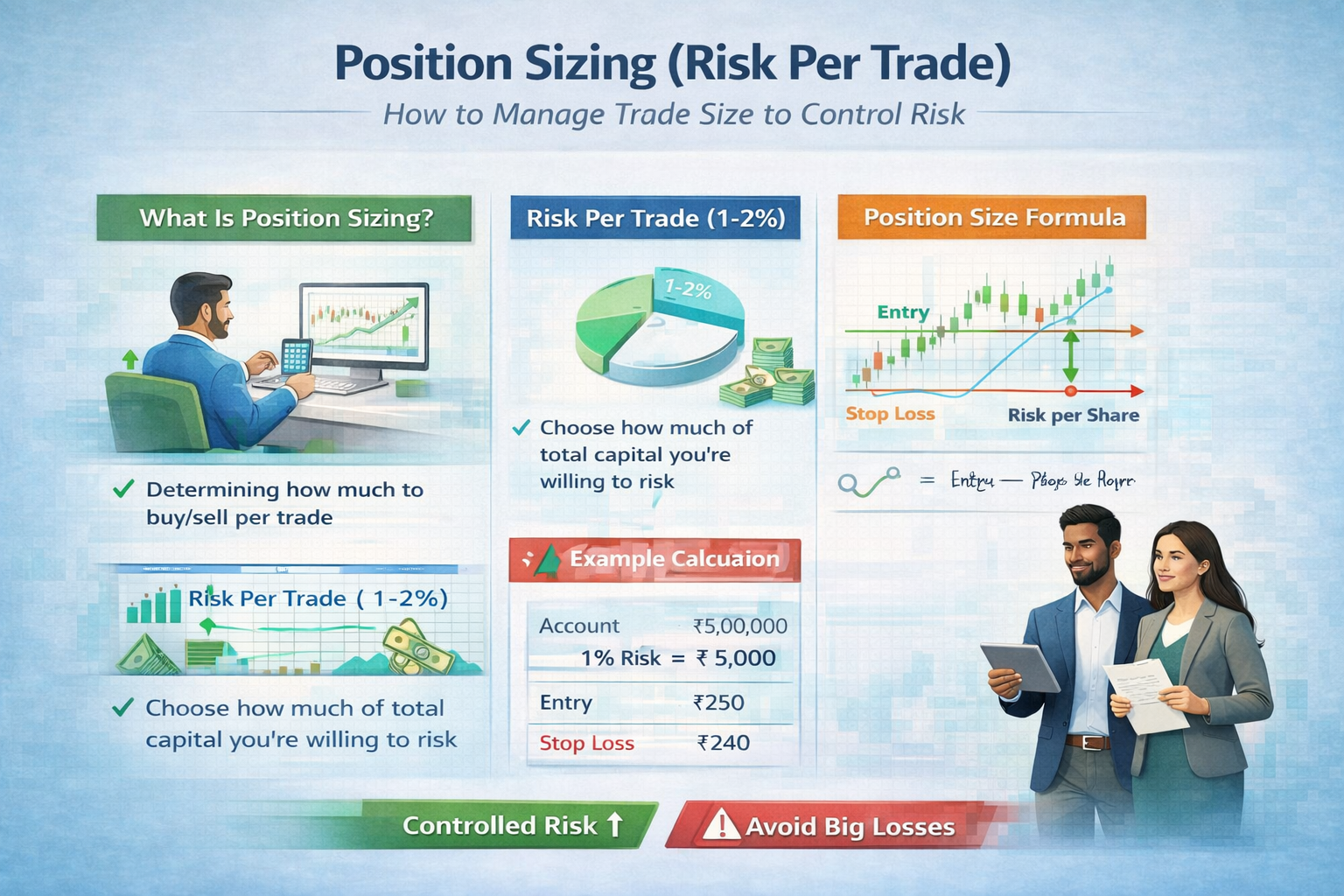
What is Position Sizing (Risk % per Trade)?
Position sizing is a risk management method that determines how much of your capital to risk on each trade, usually as a percentage (such as 1% or 2%). It’s the difference between playing the investing game for the long term—or blowing up your account in a hurry.
- Meaning: Choosing how big or small your trade should be, based on how much money you’re willing to lose if wrong.
- Essence in one line: Position sizing = Protecting your trading capital by not risking too much at once.
Step-by-Step Guide: How to Use Position Sizing
- Choose Your Risk Percentage
Most beginners start by deciding to risk 1% or 2% of their total account per trade. This means if you have $1,000, only $10-$20 is at risk on one trade.
- Calculate Dollar Risk
Decide where your stop-loss goes. What is the distance (in price) from your entry to where you’ll exit if wrong? Multiply this by the number of shares or contracts.
- Find Your Position Size
Use the simple formula:
Position Size = (Account Value × Risk%) / (Entry Price – Stop-Loss Price)
- Execute the Trade
Enter only the number of shares or contracts you calculated in step 3. Do not exceed your planned position size.
- Stick To Your Plan
No exceptions! Review your trades regularly to make sure you’re following your position sizing rules.
Example: You have $2,000. You want to risk 2% ($40). Your stop-loss is $0.50 below entry. Position Size = $40 / $0.50 = 80 shares max.
Breaking Down Position Sizing in Detail
- It’s about percentages, not dollars: The rule adapts as your account grows or shrinks.
- Protects you from major losses: A few bad trades won’t wipe out your capital.
- Works with any market: Stocks, forex, crypto, futures, and more.
- Helps take emotions out of trading decisions: No more “all in” gut feelings.
Advantages of Position Sizing (Risk % per Trade)
- Limits Your Losses: You control how much you’re willing to lose each time, reducing emotional pain and stress.
- Fosters Consistency: Position sizing builds discipline and a long-term mindset.
- Adapts to Win/Loss Streaks: Your risk reduces during losing streaks, protecting you; increases slowly during good periods.
- Works for Any Account Size: Practical for both small and large accounts.
Disadvantages (if Any)
- Slow Growth for Small Accounts: Risking only 1% per trade means small profits at first.
- Requires Discipline: It’s easy to ignore your plan and risk more after a winning streak.
- Can Be Complex with Multiple Positions: If you have many trades open, tracking total risk can get confusing.
Alternative Investment Options
- Index Funds: Spread your risk over hundreds of companies—instead of picking single trades.
- ETFs (Exchange-Traded Funds): These follow different asset classes and are less risky than single stocks.
- Robo-Advisors: Automated investment platforms that use smart algorithms for risk management.
- Mutual Funds: Professionally managed and diversified, suitable for hands-off investors.
Beginner’s Tips
- Always set a stop-loss—never leave a trade open-ended.
- Start with risking no more than 1% per trade until confident.
- Use a trading journal to track how well you’re sticking to your position sizing plan.
- Review and adjust your risk level if your account grows (or shrinks).
Tip: If you’re ever in doubt, risk less, not more. Long-term survival matters most!
Advanced Variations for Experienced Traders
- Kelly Criterion: A formula to maximize potential growth based on your odds of winning and losing.
- Volatility-Based Sizing: Adjusts position size by how much the asset typically moves (more volatile, smaller position).
- Scaling In & Out: Enter a position in stages as price moves in your favor—or scale out to lock in profits.
- Portfolio-Level Risk Controls: Keep total open position risk below a set percentage of your account.
Pro Tip: Even advanced techniques must respect your overall risk tolerance and capital preservation principles.
FAQs: Position Sizing (Risk % Per Trade)
Q: What’s the safest % to risk per trade?
A: Between 1% and 2% is considered best for most traders—big enough to matter, small enough to keep you safe.
Q: Should I use the same position size every trade?
A: No, adjust based on your stop-loss and risk percentage. That’s the essence of effective position sizing.
Q: Why do most traders ignore position sizing?
A: Many are focused on making quick gains or don't realize how crucial risk control is to survival and success.
Conclusion
Mastering position sizing (risk % per trade) is a trader’s first, best defense against big losses, stress, and emotional trading mishaps. It’s a powerful, simple rule that lets you play the long game, whether you’re just starting out or already experienced. Remember—preserving your trading capital means you’ll always have another chance, no matter what the market does today.